Ten Vendors Will Sell You a Digital Twin... But They Are Selling Four Different Things.
Autodesk, Bentley, Xylem, DHI, Veolia, and the challengers all sell water utility digital twins. A buyer's comparison of platforms, pricing, and proof.
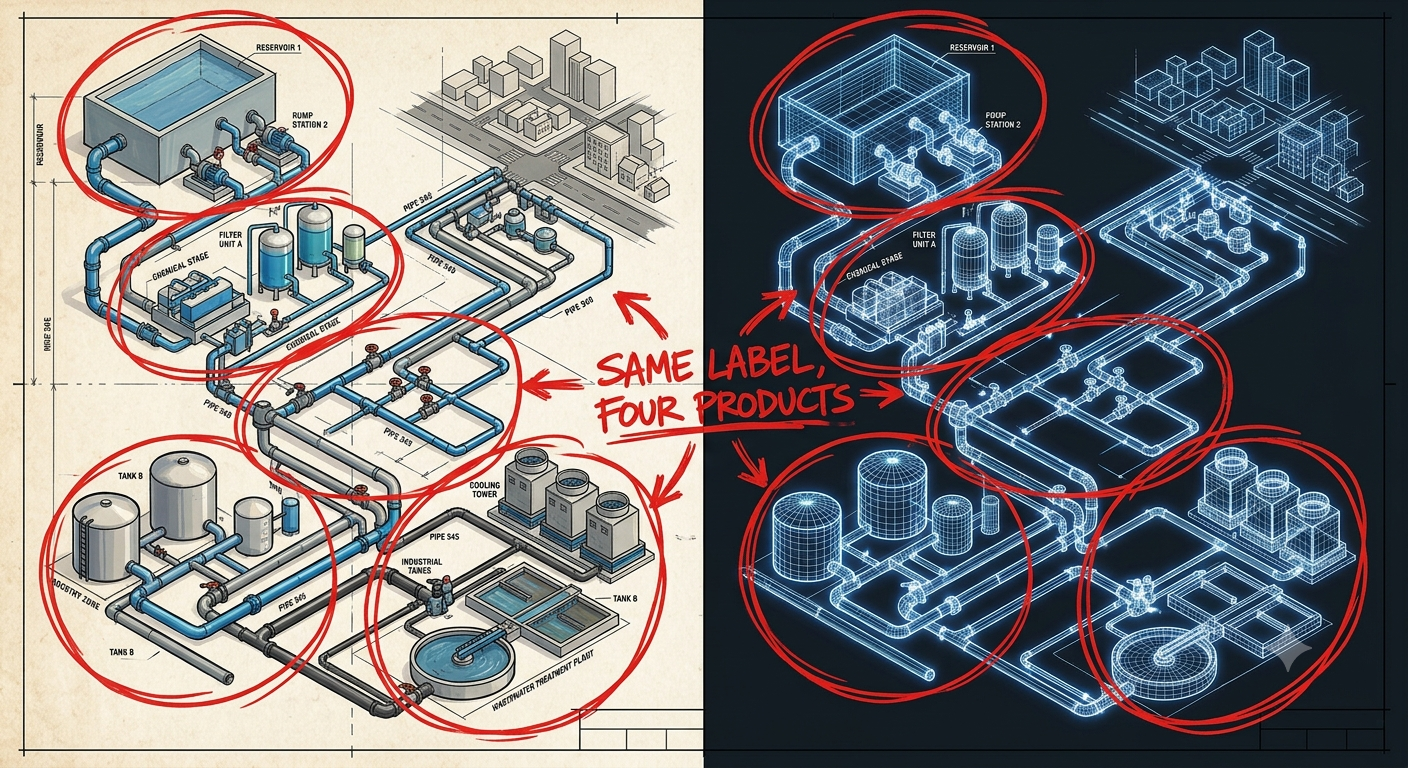

The short version: ten vendors sell water utility digital twins and they’re selling four different products, which is why head-to-head comparison usually goes nowhere. Pick the lane that matches your funded problem first, then weigh evidence quality inside it. Network operations points to Bentley OpenFlows WaterSight, Autodesk Info360 Insight, Xylem Vue, or Qatium. Plant optimization points to DHI CityFlow Live, Veolia Hubgrade, Siemens gPROMS, or Aquasight. Capital prioritization points to asset analytics. Almost every outcome number in this market is vendor-published, and the few with outside validation are flagged in the table below. This comparison is maintained by HydroKnowledge, which advises water utilities and investors on technology evaluation and procurement.
A while back I wrote a plain-language guide to what a digital twin is and whether your utility needs one. The follow-up question naturally is, “Great, now which one should I pick?” Like most answers in the water world, ‘it depends’ is the one I’ll give you. Why? The vendors who show up to answer an RFI are selling different products under the same label. Comparing Bentley to Veolia head-to-head is comparing apples to oranges. One sells you software, the other sells you an operating relationship with software inside it.
So before we talk about which one is the best choice for a given water utility, let’s sort the market into four clean (at least in my head) categories:
- The modeling houses (Autodesk, Bentley, DHI). They built, or acquired, the hydraulic and process models engineers already use and their twin products connect those models to your live data.
- The integration platform (Xylem Vue, built on GoAigua). A vendor-agnostic data layer, built inside a working utility, with twin modules on top.
- The operator twins (SUEZ Aquadvanced, Veolia Hubgrade). Software plus staffed monitoring centers, usually arriving attached to an operations or performance contract.
- The specialists and challengers (Siemens, AVEVA, Qatium, Aquasight, and a slew of startups). Point solutions, data backbones, and low-cost entry points that solve one problem well.
Now I KNOW there are people who will come at me with pitchforks for these categories. Some vendors stretch across a couple of them and it feels like new vendors/startups pop up every day and I’m missing a bunch of those (AlphaBravo AI, MentorAPI, Effluent.AI, etc…). Regardless of exactly where the companies fit, I believe these categories are accurate representations of both the vendors themselves and how water utilities should be thinking about procuring them.
Now for the fun stuff - here’s the field at a glance, with actual documented results or case studies I could find for each and where that evidence comes from. Important note - As of mid-2026 almost every outcome number in this market is vendor-published. The jury is still out on which ones utilities prefer.
| Platform | What the twin actually is | Best documented result | Pricing (mid-2026) |
|---|---|---|---|
| Autodesk Info360 Insight + InfoWorks | Network and plant operational analytics on top of the InfoWorks/InfoWater modeling engines | Wellington Water (NZ): 20% pump energy savings, utility-estimated | Quote-only for Info360; desktop modelers listed from $5,500/yr |
| Bentley OpenFlows WaterSight | Cloud network twin unifying SCADA, GIS, hydraulic model, and customer data | Sabesp (Brazil): 30% fewer sewage overflows, vendor-published | Quote-only for WaterSight; WaterGEMS listed $1,021 to $16,782/yr (OpenFlows Water tiers, incl. WaterGEMS) |
| Xylem Vue (GoAigua) | Vendor-agnostic integration layer plus network, sewer, and plant twin modules | South Bend (IN): CSO volume down more than 80%, independently corroborated | Quote-only |
| DHI MIKE+ / CityFlow Live | Physics-first planning models that carry directly into operational twins | Bresso-Niguarda WWTP (Milan): live plant twin on 60+ sensors, peer-review documented | Public list prices, roughly €120 to €750 per user/month |
| SUEZ Aquadvanced | Network monitoring, pump scheduling, and drainage twins, sold standalone or in concessions | Tarragona (Spain): up to €700k/yr energy savings, client-attributed | Quote-only |
| Veolia Hubgrade | Staffed monitoring centers plus a closed-loop treatment process twin | Køge (Denmark): 35% lower energy costs, vendor-published | Bundled with service contracts |
| Siemens SIWA / gPROMS | AI point apps for leaks and blockages, plus mechanistic plant process twins | Yorkshire Water (UK): 9 in 10 sewer issues caught up to two weeks early, university-validated | Subscription, quote-based |
| AVEVA (Schneider Electric) | PI System data backbone, operations dashboards, and the ex-AQUIS hydraulic twin | White House Utility District (TN): $900k recovered over two years, vendor-published | Flex credit subscription, quote-based |
| Qatium | Browser-based network twin built for non-modelers | Anglian Water (UK): field techs running simulations from phones, qualitative | Free tier; enterprise by quote |
| Aquasight | AI plant and network optimization for North American municipals | Haverhill (MA): 15.7% energy reduction, ~$185k/yr, state-pilot documented | Quote-only |
How to read the table. Pricing comes from vendor list prices where a vendor publishes them and is marked quote-only where none is public. Results are labeled by source. Vendor-published means the figure rests on the vendor’s word alone. Client-attributed, university-validated, independently corroborated, and peer-review documented all mean someone outside the sale stated or checked it.
The modeling houses: Autodesk, Bentley, and DHI
Autodesk bought Innovyze in 2021 for $1 billion and with it the software a large share of the world’s networks are already modeled in: InfoWorks ICM for sewers and catchments, InfoWorks WS Pro and InfoWater Pro for distribution. The operational twin is Info360 Insight, which connects those models to live sensor data for incident detection, forecasting, and what-if simulation. (You may still see “Info360 Twin” in old marketing. No product by that name exists today.) In late 2025 Autodesk moved Info360 to capacity-based subscriptions: unlimited users, priced by sensor channels and asset counts, which removes the per-seat math that used to keep operators out of the software. The deepest Esri integration in the field is here, and if your models are already InfoWorks files, the path to a twin is shortest with Autodesk. The watch-outs: pricing for Info360 is quote-only, the portfolio has been renamed and re-bundled repeatedly since the acquisition (Info360 Plant was retired in December 2025 and folded into Insight), and the forced march from perpetual licenses to subscription left bruises documented in Autodesk’s own FAQ. The flagship public result, Wellington Water’s 20% pump energy savings, is utility-estimated and delivered through Stantec.
Bentley’s answer is OpenFlows WaterSight, a cloud environment that pulls SCADA, GIS, the hydraulic model, and customer information into one place with live water-audit and energy analytics. Its reference list is the most international of the group: Sabesp in São Paulo reports 30% fewer sewage overflows and one project’s engineering work hours falling from 1,200 to 120 on its OpenFlows Sewer work (WaterSight handles the real-time supply monitoring there), Nagpur, India brought a citywide twin’s first phase live in February 2025, and Porto’s H2PORTO platform runs the whole urban water cycle on OpenFlows models. US deployments are earlier-stage; a mid-Atlantic partner push began in 2025. On the desktop side, Bentley folded WaterGEMS into OpenFlows Water in July 2024, which lists at $1,021 to $16,782 per year by pipe count and tier, with the WaterGEMS-level capability in the Advanced and Ultimate tiers; it is the rare public price in this market. The recurring complaint to know about before you sign: Bentley’s term-license model lets usage exceed purchased seats and bills the overage quarterly, and administrators cannot cap it.
DHI is the odd one out in the best way: a Danish not-for-profit research institute rather than a software conglomerate. Its pitch is model continuity. The same MIKE+ file your engineer builds for planning becomes the live model behind WaterNet Advisor for distribution monitoring, and its WEST treatment models feed CityFlow Live, the platform that consolidated DHI’s plant, sewer network, and receiving-water twins in September 2025. The Milan-area Bresso-Niguarda plant twin, running on more than 60 online sensors with a 24-hour forecast horizon, is documented in the peer-reviewed literature. DHI is also the only vendor in this article that publishes list prices: WaterNet Advisor from roughly €120 per user per month, MIKE+ modules from €550. The trade-offs are a thin North American footprint and case studies that lean on vendor-claimed percentages more than audited utility numbers.
The integration platform: Xylem Vue
Xylem Vue is the platform formerly known as GoAigua, built since 2009 inside Global Omnium, the utility group that runs Valencia, Spain. Xylem took majority ownership in December 2024. Its origin shows: the Valencia twin integrates more than 20,000 data readings from SCADA, smart meters, and quality sensors into real-time hydraulic modeling, and the deployment is documented in peer-reviewed literature, which is rare in this market. The design premise is vendor-agnostic ingestion, so it sits on top of whatever sensors, meters, and SCADA you already own.
The results that stand out are on the wet-weather side, inherited from Xylem’s EmNet acquisition. South Bend, Indiana cut combined sewer overflow volume by more than 80% and avoided nearly $450 million in capital work, a figure the University of Notre Dame, where EmNet was spun out, reported from the city’s revised long-term control plan, which makes it the best-documented capital-avoidance number any vendor can point to. Cincinnati’s MSD reports 247 million gallons of overflow avoided per year and $38 million in deferred capital; Buffalo reports $145 million saved against its long-term control plan. On the drinking-water side, Hot Springs, Arkansas cut non-revenue water from 44% to 24%, and the Cuxhaven treatment plant in Germany reduced aeration 30%, worth about 1.2 million kWh per year. Caveats: outside South Bend and the peer-reviewed cases, most numbers are vendor-published, pricing is entirely quote-based, and you are buying into a platform whose job is partly to unify Xylem’s own acquisition portfolio.
The operator twins: SUEZ and Veolia
These two require a different mental model, because the product is a relationship with software inside it. Veolia Hubgrade pairs 60+ staffed monitoring centers with the ex-Krüger AQUAVISTA process twin, now called Hubgrade Performance Plant, which runs at over 100 treatment plants and actually closes the loop: it pushes optimized setpoints to the PLC in real time. Closed-loop control is the exception in this entire market, and Veolia can do it partly because it operates so many of the plants involved. Vendor-published results include a 35% energy cost reduction at Køge, Denmark. The flagship is the SEDIF contract for Greater Paris: €4 billion over 12 years, with a full digital twin of roughly 8,000 km of network as the centerpiece. Veolia opened its first North American Hubgrade center in Scottsdale in September 2025, so this model is now a live option for US utilities.
SUEZ Aquadvanced covers network monitoring and leak pre-localization, pump-schedule optimization against a real-time hydraulic twin, and urban drainage. SUEZ has a stronger record than Veolia of selling the software standalone to utilities it doesn’t operate: Tarragona, Spain has run Aquadvanced pump optimization since 2014, with savings up to €700,000 per year in a SWAN-published, client-attributed case study, and Scottish Water’s Balmore trial reported 10% energy reduction. If you intend to keep operations in-house, the question to press both companies on is what the software costs and does when it arrives without the service contract around it.
The specialists and challengers
Siemens sells SIWA, a family of AI point apps, plus gPROMS mechanistic process twins for treatment plants. One SIWA result towers over everything else in this article for evidence quality: Yorkshire Water deployed the Blockage Predictor across 2,000 sewer overflow sites, and the University of Sheffield’s independent analysis of 21,300 days of data found it caught 9 in 10 developing issues up to two weeks early, detecting 88.4% of confirmed problems against 26.6% for the tool it replaced. That is what third-party validation looks like, and it is nearly unique in this market. The limitation is scope: SIWA apps solve specific problems and assume you pair them with someone else’s network model.
AVEVA, owned by Schneider Electric, is the data backbone under many twins that carry other logos. The PI System historian is the industrial standard for operational data, and utilities get real money out of it on its own: White House Utility District in Tennessee found a $300k-a-year leak in under four days, recovered $900k of water over two years, and deferred $15-20 million in capital. The hydraulic twin itself is the former AQUIS product, rebranded EcoStruxure Water Cycle Advisor. Know before buying that AVEVA has moved to its Flex credit subscription model, and the migration away from perpetual PI licenses has generated real friction in its user community.
Qatium is the low-friction entry point: a browser-based network twin designed so operators, engineers, and managers can run simulations without a modeling specialist. The free tier covers systems up to about 8,000 connection points and 80 km of pipe with three users, which puts a functioning digital twin within reach of utilities that could never fund one before. Anglian Water uses it to put hydraulic results in front of staff who never open a modeling package. Published quantified outcomes are thin so far, and the advanced features sit behind enterprise pricing, but as a first step it has no cheaper competitor.
Aquasight, out of Michigan, is a small founder-run AI platform with real numbers at named US municipal plants: the state-sponsored pilot at Haverhill, Massachusetts cut treatment energy costs 15.7% (about $185,000 and 605,000 kWh per year), and Central San in California cut influent pumping from $50 to $35 per million gallons using its APOLLO plant twin. It claims 120+ utility partners, mostly small and mid-size North American systems. The flip side of a small vendor: little growth capital behind it, so weigh vendor durability accordingly.
How a water utility should choose a digital twin
Start from the question, and the tool follows. Network losses, pressure management, and main-break response point to a network twin (WaterSight, Info360 Insight, Xylem Vue, Qatium). Plant energy and chemical optimization point to a process twin (CityFlow Live, Hubgrade Performance Plant, gPROMS, Aquasight). Capital prioritization points to asset analytics (Info360 Asset and its competitors). Nobody sells one twin that does all three well, whatever the platform diagram implies.
Expect advisory mode, and plan governance for it. A 2025 peer-reviewed survey of full-scale deployments found that advisory-only operation is the norm: the twin recommends, a human decides. The constraint is governance and how completely your safety logic can be encoded, so budget the twin as decision support. Fully autonomous, 24/7 operation at scale has not been publicly documented anywhere in the water sector - although that story is quickly changing with the adoption of A.I. Regulations will have to catch up for this to become a reality.
Audit the evidence like a skeptic. I want to reiterate that there are vendor-published percentages everywhere, independent validation almost nowhere. Sheffield’s analysis of Yorkshire Water stands out because someone outside the deal checked the math; Notre Dame’s South Bend reporting is closer to home, since EmNet began as a Notre Dame spinout. Ask every finalist for post-implementation numbers a named client will attribute on a reference call. The same discipline applies here as when you evaluate a vendor’s cybersecurity claims: the claim is marketing until someone shows you the receipts.
Treat your data as the real project. When SWAN and BlueTech surveyed utilities, the top implementation barrier was data normalization, the unglamorous work of mapping asset IDs across SCADA, GIS, CMMS, and billing. Black & Veatch’s 2025 report found 54% of utilities citing staffing and 37% citing funding as the binding constraints, and only 28% saying they both collect extensive data and use it well. A twin without a calibration and data-maintenance budget decays into an expensive dashboard. If you are mid-flight on an AMI rollout, that data layer is a prerequisite worth sequencing first.
Price in the consolidation trend. Emagin, the standout AI-native startup of 2018, was folded into what became Autodesk’s Info360 line, and Transcend may be soon to follow (they secured funding from Autodesk in 2023). Digital Water Works took a strategic investment from Bentley. Xylem holds a majority stake in Idrica. Buying from an independent means underwriting the odds it gets acquired mid-contract, so negotiate data export rights and ownership of your model files while you still have leverage.
FAQ
What is the best digital twin software for water utilities?
There is no single leader; the market splits by problem. For distribution network operations, the established options are Bentley OpenFlows WaterSight, Autodesk Info360 Insight, and Xylem Vue, with Qatium as the low-cost entry. For treatment plant optimization, look at DHI CityFlow Live, Veolia Hubgrade Performance Plant, Siemens gPROMS, and Aquasight. For sewer and wet-weather management, Xylem Vue’s ex-EmNet modules and Siemens SIWA Blockage Predictor carry the strongest published results. Shortlist by the problem you are funding, then compare evidence quality within that lane.
How much does a digital twin cost for a water utility?
Public price points are scarce. DHI publishes list prices (WaterNet Advisor from roughly €120 per user per month, MIKE+ modeling modules from €550). Bentley’s OpenFlows Water (which now includes WaterGEMS) lists at $1,021 to $16,782 per year by network size and tier, and Autodesk’s InfoWorks ICM lists at $5,500 per year for the Sewer tier, $7,500 for Flood, and from $18,000 for Ultimate. The operational twin platforms themselves (Info360 Insight, WaterSight, Xylem Vue, Aquadvanced) are quote-based, scoped to network size and sensor counts. Qatium offers a free tier for small systems. In practice the software subscription is often the smaller line; integration, model calibration, and ongoing data maintenance carry the budget.
What is the difference between a hydraulic model and a digital twin?
A hydraulic model is built and calibrated periodically for planning studies. It becomes a digital twin when it is continuously synchronized with the real system, ingesting live SCADA, sensor, and meter data so it reflects current conditions and can forecast forward. The modeling-house vendors (Autodesk, Bentley, DHI) sell exactly this progression: the planning model you already own becomes the engine of the operational twin. The full breakdown is in my plain-language guide.
Should a small utility buy a digital twin?
The barriers that made twins a large-utility purchase are falling. Qatium’s free tier covers systems up to roughly 8,000 connections, and Aquasight built its business on small and mid-size North American municipals. The real prerequisite is data: a twin amplifies good SCADA, metering, and GIS records and faithfully reproduces bad ones. If your asset data and telemetry are shaky, spend the first dollars there; the twin will still be waiting, cheaper and better, when the foundation is ready.
HydroKnowledge advises utilities on water technology evaluation and purchases, including building the requirements, shortlists, and reference checks that separate vendor claims from evidence. Get in touch if a digital twin decision is on your desk.
Related insights
Working on something in water?
HydroKnowledge works with water technology companies, utilities, and investors on go-to-market strategy, AI adoption, and advisory services.
Start a conversation