Understanding How Engineering Firms Specify Vendors
Engineering firms carry the liability when a specified product underperforms. Here's the practical checklist serious specifiers use before putting a new vendor in a preliminary engineering report (PER).
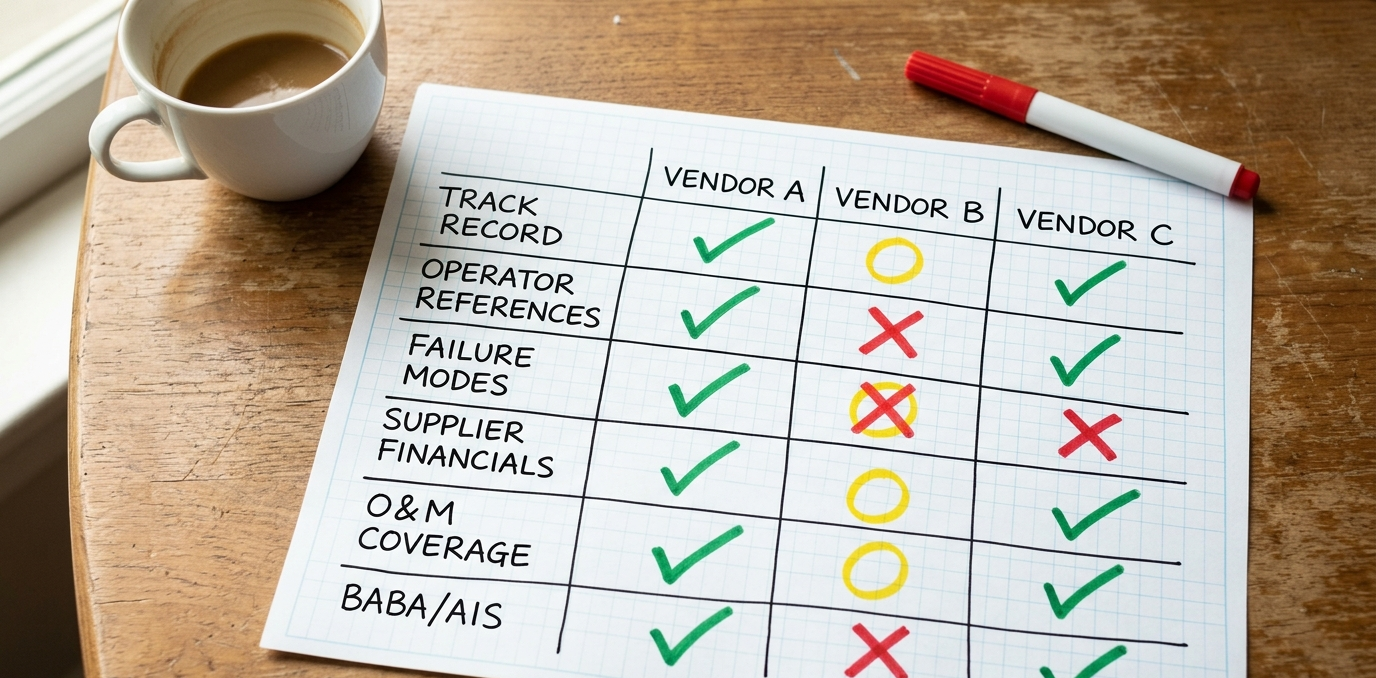

A consulting engineer who specifies a new product into a water utility’s project is, in a quiet way, putting their firm on the hook for it. If that product underperforms after startup, the engineer’s name is on the stamped drawings, the firm’s insurer is the one fielding the claim, and the utility’s general manager is the one whose reputation took the visible hit. Vendors talk about “getting specified” as if it’s a marketing problem. From the other side of the desk it’s a risk decision, and a careful one.
That asymmetry is the reason serious engineering firms apply more rigor to vetting new water technology than most people outside the design world realize. It’s also the reason the bar can feel arbitrary to vendors who haven’t been on the receiving end of an underperforming spec. This post is for the engineers, project managers, and principals who write those specs (and for the founders trying to understand what they’re being measured against). It’s a working checklist of what serious evaluation actually looks like, why each piece of it matters, and where the common failure modes live.
What “vetting” really means at an engineering firm
A design engineer evaluating a new water technology is not running a science fair. The job is not to identify the most innovative product on the market. The job is to specify equipment that will work, at the scale and conditions of this particular project, for the asset life the utility is paying for, with a supplier who will still be answering the phone in year seven.
Early-stage water tech vendors who haven’t been through the process expect to answer questions like “How well does it work in the lab?” and anticipate the engineer will be ‘over the moon’ when the vendor’s answer is “YES! And we have all the data to prove it!”.
That’s not the question vendors get. It’s usually something like “Does it work, in plants that look like this one, under operators who look like ours, at flows that look like ours, and has it been doing so for long enough that the bathtub curve has stopped scaring me?”. Most early-stage water tech vendors can nail the lab question… but the job of the specifier is to answer the second.
The companion post on how engineering consultants quietly decide which water technology gets bought outlines practical steps vendors should take to think about consultants as a channel to utilities. What follows here is the second order of operations - what the specifier actually checks (or should be checking) before recommending a new product into a project.
The practical checklist
1. Operating track record at relevant scale
The first filter is the simplest and the most decisive. Has this product run continuously, at a scale comparable to the project, in conditions comparable to the project, for long enough that the data is meaningful?
“Comparable scale” is the part vendors most often gloss. A membrane system that has run beautifully at 0.5 MGD for two years is not a 10 MGD reference. A SCADA-integrated optimizer that has been deployed at a 60-loop plant is not a reference for a 600-loop system. The non-linearities in water treatment (hydraulics, biology, chemistry, controls) mean that scale-up evidence has to be either directly comparable or carefully argued, not assumed.
“Long enough” deserves the same scrutiny. A first-year installation is honeymoon data. The interesting performance signal arrives in years three through five, when membranes have fouled and been cleaned, pumps have been rebuilt, controls have been re-tuned through three operator generations, and the supplier has had time to fail or follow through on warranty work. If a vendor’s strongest reference is a six-month pilot, that’s a flag the question itself isn’t being answered.
2. Reference installations the specifier can verify directly
Marketing materials list reference installations. Vetting requires more: the willingness of the reference utility’s plant superintendent or chief operator to take a phone call and answer specific questions on the record. A vendor who can produce three operators, field superintendents, IT professionals, etc. willing to talk candidly about what’s broken, what they wished they’d known, and what they’d buy again is a different vendor from one who controls reference access tightly.
The specifier’s call is a diligence call. The questions worth asking the operator: how often does it require intervention beyond the routine? What’s the failure mode you most commonly see? Did the commissioning team leave you with the documentation and training you needed, or did you have to rebuild that yourselves? When you have a problem, how long does it take to get a real engineer on the phone (or to the site itself)? Would you buy it again, knowing what you know now?
Three of those calls usually tell the whole story.
3. Failure modes documented honestly
A useful diligence question is “what’s the worst failure mode this product has experienced in the field, and what changed afterward?” Vendors who answer it candidly are almost always safer specifications than vendors who deflect. Every operating water technology has at least one failure mode the market has discovered the hard way. Pretending otherwise is a sign that either the vendor doesn’t know yet (early-stage immaturity) or doesn’t want the engineer to know (which is worse).
A defensible spec is one where the failure modes are visible in the engineer’s evaluation memo. The utility’s risk officer can read it, the EOR’s insurer can read it, and everyone can see that the engineer went in with eyes open. A spec that omits known failure modes is a spec that gets quoted in a deposition.
4. Supplier financial health and continuity
Water infrastructure is long-lived. A pump bought in 2026 is expected to be supported in 2046. A vendor that disappears, gets acquired into a portfolio that deprioritizes the product line, or pivots to a different market segment leaves the utility holding orphaned equipment and the EOR holding part of the blame.
The vetting questions: how many years of runway does this vendor have at current burn? Who are the institutional investors and what are their typical hold periods? Has the product line ever been sold or spun out, and what happened to support continuity through the transition? Is there a service organization the size of the install base, or is it three engineers covering forty plants? For larger contracts, the engineering firm’s procurement team often asks for audited financials directly. For smaller vendors, the conversation is more candid and less formal, but it should still happen.
Financial fragility is not disqualifying on its own. Plenty of consequential water technologies launched out of fragile companies and survived. It is; however, a factor in the specification language. A spec that names a fragile vendor as a sole source is reckless but a spec that names that vendor alongside an established alternative is defensible.
5. Post-installation support footprint
Specifying a product is also specifying the relationship that follows it. The vendor’s service organization is going to be the utility’s partner for the equipment’s operating life. Two questions deserve direct answers.
The first is geographic coverage. Where are the service technicians physically located, and what’s the response time for a critical fault at this project’s location? A vendor whose nearest field engineer is in another state is a different proposition from one with a depot two hours from the plant.
The second is service-organization depth versus install-base growth. A vendor scaling fast can outrun its own service capacity. The early-installation operators get great service because they were first; the operators commissioned eighteen months later wait three days for a return call. This is one of the most consistent failure patterns in water tech support and the easiest to miss in vendor diligence. Ask install-base operators directly about response times because the data is not in the marketing deck.
6. Regulatory and code acceptance
Specifying a new technology can trigger a separate review with the state primacy agency (drinking water) or the state permit writer (wastewater). Whether and how that review goes is part of the vetting process. NSF/ANSI 61 certification on wetted materials, UL listing on electrical components, third-party validation of treatment performance (where applicable), and any state-specific acceptance procedures all live on the checklist. A vendor whose product cannot be approved by the regulator who has to approve the project is a vendor whose specification cost the project a year.
This piece is also where federal funding rules intersect. Projects funded with State Revolving Fund dollars trigger Build America Buy America (BABA) and American Iron and Steel (AIS) compliance, plus Davis-Bacon prevailing wage requirements. A foreign-manufactured component without a BABA waiver in hand makes the spec ineligible on a funded project. The companion piece on SRF mechanics from the vendor side covers the funding picture; on the engineering side, the practical move is to ask vendors for compliance documentation before recommending the product, not after.
7. Performance data quality
Vendors present performance data. The job of the specifier is to understand what kind of data it is. Three categories are worth distinguishing, because they carry very different weight.
The strongest category is third-party-validated operating data from a full-scale, comparable installation. This is the gold standard.
The middle category is operating data the vendor has collected itself from full-scale installations, with raw data the engineer can request and inspect. Useful, but the engineer needs to look at it.
The weakest (and most commonly presented) category is pilot or demonstration data, often from a controlled trial at the vendor’s facility or a partner research institution. This is necessary to have but not sufficient to specify. A pilot proves the technology can work; it doesn’t prove the supplier can deliver, commission, and support it at scale.
A specifier who treats all three categories as equivalent is going to make poor decisions. A specifier who insists on the strongest category is going to specify only mature products, which is sometimes appropriate and sometimes leaves real value on the table.
8. Spec defensibility
The last item is reflexive. After the engineer has done the evaluation work, the resulting specification needs to be defensible to three audiences: the utility’s procurement department, an aggrieved competitor who didn’t make the short list, and a future arbitrator if something goes wrong.
A sole-source specification needs an unusually strong justification. A two- or three-name specification with a documented basis-of-design memo is more defensible. An open performance specification with prequalification language is the most defensible of all, but also requires the most diligence work upstream to define what the prequalification actually filters for.
The defensibility question is not separate from the engineering question. A spec that cannot be defended is one the firm shouldn’t be writing.
Common evaluation failures
A few patterns show up repeatedly when an evaluation goes badly.
The first is over-weighting a charismatic founder. New water technology often comes with a compelling story and a compelling person telling it. Both of those are important signals, but neither is evidence the product works at the project’s scale. A vendor evaluation that turned on a great meeting and a great pitch deck is a vendor evaluation that hasn’t happened yet.
The second is under-weighting operator interviews. Operators (and I use that term loosely - we could be referring to customer service professionals, meter professionals, internal engineers, etc. - basically anyone in the utility who is impacted by a new product or service) are the people who actually live with the solution. Their feedback is often direct, sometimes blunt, and almost always more useful than vendor marketing. Engineering firms that skip operator interviews because the vendor “isn’t comfortable” sharing reference contacts are accepting a constrained dataset on the vendor’s terms.
The third is letting the project schedule override the evaluation. When the design schedule slips and the spec needs to lock by Friday, the temptation is to defer the unanswered questions and specify the vendor anyway. The questions don’t go away; they just resurface during commissioning or year two of operation. A short conversation with the utility about extending the schedule for two weeks is almost always cheaper than the consequences of a hurried spec.
The fourth is conflating “I’ve used this vendor before” with “I’ve vetted this vendor for this application.” A vendor whose product worked beautifully on a 5 MGD groundwater plant is not pre-vetted for a 25 MGD surface water plant.
The asymmetry that drives the bar
Most of the rigor above exists because the consequences of a bad specification and the consequences of a missed innovation are not symmetric. A specifier who passes on a strong new technology loses an opportunity. A specifier who recommends a bad one loses a client, a reputation, and possibly a deductible.
That asymmetry is not unreasonable, but it has a cost. It’s the structural reason new water technology takes longer to diffuse than founders expect, and it’s the reason the most consequential adoption signal a vendor can earn is not a marketing award but a senior engineer at one of the major firms saying, on the record, that they would specify the product on their next project. That sentence is the output of the checklist above being satisfied. It cannot be shortcut.
Practical recommendations for firms
For a firm that wants to evaluate new water technology more systematically than the ad hoc approach most groups currently use, a few moves translate to measurable improvement.
Build a standing internal evaluation framework. The checklist in this post is a starting point. A formalized one-page memo template, applied to every new vendor before specification, gives the firm an institutional memory and a defensible audit trail. The principals in the practice should agree on the template and review the memos.
Operate a vendor watch list ahead of project demand. Most firms react to vendor outreach when a project triggers it. Stronger groups maintain a running list of promising technologies in each application area, with reference installations being tracked over time. By the time the project shows up, the homework is already partially done.
Invest in operator network depth. The engineers in the firm who maintain strong relationships with plant superintendents at reference installations are the engineers who can run the diligence calls in twenty minutes instead of three weeks. That network is a firm asset, not an individual one. It should be cultivated deliberately.
PLEASE PLEASE PLEASE be honest with vendors about where they are in the evaluation. Vendors invest real time in pursuing engineering relationships. The kindest and most professional thing a firm can do is tell them clearly: “You’re on the watch list but the reference installations aren’t there yet,” or “You’d be specifiable today on a project of this size; we don’t have one in the pipeline,” or “We’re not going to specify you, here’s why.” Vague encouragement that leads nowhere is the worst of all worlds for both parties.
The bottom line
Vetting new water technology is one of the most consequential things an engineering firm does, and one of the least systematized. The checklist above isn’t a formula; it’s a way of making sure the right questions get asked before a firm’s name goes on a stamped drawing. The firms that do this well end up with a reputation among utilities for picking products that work, and a reputation among vendors for being demanding but fair. Both reputations are worth a lot.
The firms that do it poorly end up with a different reputation, and it travels through the operator community faster than anyone would prefer.
HydroKnowledge advises engineering firms on building practical evaluation frameworks for new water technology, and advises water tech founders on what serious specifiers are actually looking for. Get in touch if you’d like to discuss either side of this work.
Related insights
Working on something in water?
HydroKnowledge works with water technology companies, utilities, and investors on go-to-market strategy, AI adoption, and advisory services.
Start a conversation