Who Actually Says Yes at a Water Utility
Most vendors selling to water utilities chase the wrong person. The buying committee has eight roles, each with different power. Map them right.
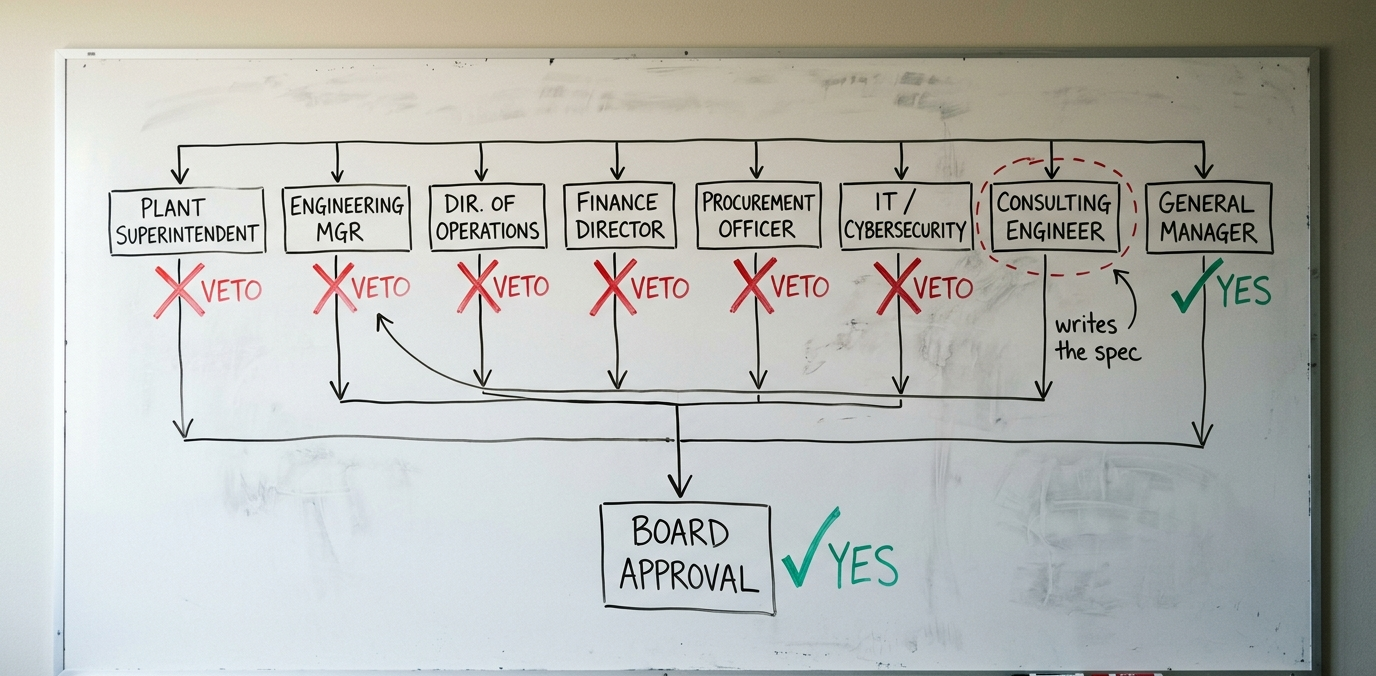

There is rarely a single decision-maker at a municipal water utility. There is a committee. It is informal, almost never named, and its members almost never sit in the same room. A vendor who walks in looking for “the decision-maker,” finds someone enthusiastic, and confuses enthusiasm for authority is about to spend three months losing a deal slowly, without ever being told it is lost.
The most common version of that mistake involves the General Manager. A vendor gets the meeting. The GM nods along with every slide, asks sharp questions about the integration plan, and ends the meeting by saying, “I think this is exactly what we need. Let’s get this moving.” Three months pass. The contract never makes it onto a board agenda. The Finance Director quietly raised concerns about the data-services line item during the next capital plan review. The Director of Operations decided the sequencing was wrong with another project already underway. The GM, perfectly sincere when he said yes, simply did not have the authority to make that yes stick.
Mapping the committee is one of the highest-leverage things a vendor can do, and most never bother (despite the information being publicly available most of the time!).
What follows is the rough anatomy of that committee: who sits on it, what each role actually controls, and how the unspoken hierarchy of veto power tends to work. Titles vary by region and utility type. The functions do not.
The plant superintendent, lead operator, customer relations manager, etc. (end-user)
This is the person who will use what you sell - and their title depends on what you are selling, of course. For purposes of this post, let’s assume you’re selling something related to water or wastewater treatment. This person could be running the treatment plant or the distribution control room. They have spent decades inside the system you are proposing to change, and they have seen vendors come and go.
They have no formal procurement authority and almost never sign anything. Their power is two-sided and easy to underestimate. On the upside, a superintendent who genuinely likes a product becomes its most credible internal advocate, because the people above them trust the operations floor more than they trust the demo. On the downside, a superintendent who quietly thinks the product is a hassle can kill it without ever raising an objection. They simply do not engage during the pilot, the data does not look as good as it should, and the project loses momentum.
Engaging them well means showing up at the plant, in steel-toes if necessary, and asking what their actual day looks like before pitching anything.
The engineering manager
In utilities of any meaningful size, the Engineering Manager (sometimes titled Director of Engineering or Chief Engineer) is the person who writes or approves the technical specifications. They own the standard that any new technology has to meet to be installed in the system.
This is one of the most important roles for a vendor to engage early, because the spec written here determines which products are even eligible to bid by the time a formal procurement begins. If your product cannot meet a particular requirement, this is where you find out, and where you may still have a chance to influence the spec before it freezes.
Engineering managers tend to be cautious by training and by habit. The system they are responsible for cannot fail in ways that hurt people, and they hold themselves accountable to that standard. They respond well to vendors who treat them as peers, and badly to vendors who treat the spec as a formality.
The director of operations or director of public works
The Director of Operations sits above the plant superintendent and the engineering team. In a standalone water utility, this might be the Director of Water Operations. In a municipal department setting, the Director of Public Works often holds water in their portfolio alongside streets, stormwater, and fleet.
This person is usually the strongest single internal voice on whether a technology purchase happens. They are the one who will go to the General Manager with a recommendation, and they are the one whose name goes on the staff report that the board reads. They are evaluating implementation risk, fit with existing operations, and how a new contract changes their team’s workload. They are also weighing all of that against every other priority on their plate.
A vendor who has earned the Director of Operations’ confidence is in a very different position than one who has only earned the superintendent’s. A vendor who has not engaged this layer at all is essentially invisible at the level where recommendations get made.
The finance director
The Finance Director or CFO does not evaluate your product. They evaluate whether there is a budget line your product can attach to, whether the cost fits the rate plan, and whether the timing works with the utility’s capital improvement program.
Their power is structural. A great product with no budget home does not get bought. A mediocre product that maps cleanly to an existing line item often does. (re-read that last sentence, it often SHOCKS companies I speak with). Vendors who never speak to the Finance Director get blindsided by sequencing problems that the operations team had no way to flag.
The most useful conversation a vendor can have with this person, often well before a deal is on the table, is a quiet one about how a future purchase might be structured: capital expense versus operating expense, multi-year subscription versus one-time installation, part of an upcoming bond program versus part of the operating budget. The answers shape the proposal more than any feature comparison.
The procurement officer
Every utility has someone whose job is to keep the procurement process clean and defensible. In a city department, this is often a centralized purchasing office. In a standalone authority, it might be a single procurement manager.
This person rarely cares about the product. They care about the process. Did the bid follow the published rules? Is the documentation in order? If a losing bidder challenges the award, can the file withstand scrutiny? They are the gatekeepers on the formal process, and they have effectively unlimited veto power over anything that looks irregular.
The mistake vendors make here is treating procurement as bureaucracy to be navigated. The procurement officer is a serious actor with a real mandate, and a vendor who shows respect for that mandate becomes much easier to work with later. Sloppy paperwork does not only lose deals on technicalities. It tells the procurement office that the vendor will be hard to work with for the life of the contract.
The general manager or utility director
The General Manager is the senior-most operational leader of the utility and is often, formally, the person who signs the contract. Inside a city department structure, the equivalent is usually the Utility Director, who reports to a City Manager or Mayor.
What is worth understanding is that the GM rarely overrides the staff recommendation that comes up to them. They are not (usually) evaluating the product on its own merits. They are evaluating whether the team below them has done its work, whether the procurement record is clean, and whether anything about the deal is going to embarrass the utility in front of the board or the public. A clean recommendation gets approved. Anything that smells off gets pushed back down for more work.
This is why the GM-only sales motion fails so often. A vendor who sells the GM and ignores the layer below has won the wrong battle. The GM will simply ask the Director of Operations what they think, and that answer will determine the outcome.
The consulting engineer
This is the committee member that vendors most often miss, and the one who frequently has the most quiet influence on the decision. Most utilities, especially small and mid-sized ones, retain an engineering firm of record for major projects. The consulting engineer writes the master plan, advises on capital projects, and frequently drafts the technical sections of the RFP.
Their influence over what gets bought is enormous and rarely written down anywhere. A consulting engineer who recommends a particular technology category, or names a particular vendor in a feasibility study, has often already made the procurement decision before the utility’s own staff gets involved.
A vendor who treats consulting engineers as a sales channel will get further faster in this market than one who only sells direct. There is a separate craft to that motion, which I have written about in selling water tech through engineering consultants, but the short version is that the engineer is on the committee whether you invite them or not.
IT and cybersecurity
Ten or so years ago this title would not have been on the list as a regular occurrence. Today, any technology that touches the SCADA network, customer data, or the operational control system is going to involve the utility’s IT director and, increasingly, a dedicated cybersecurity officer. The recent EPA water cybersecurity expectations and a string of high-profile intrusions have moved this from an afterthought to a gating function.
This role typically has veto power, not yes power. They can stop a purchase cold over a network access concern, a poorly documented data flow, or a vendor whose security posture they do not trust. They almost never push to buy anything.
Vendors should expect a security review and prepare for it the way they would prepare for financial diligence: a clean and current SOC 2 report, a documented data map, and a willingness to work with whatever VPN, segmentation, or access control architecture the utility already uses.
The governing board
Most capital expenditures above a threshold (commonly $25,000 to $250,000, depending on the utility) require approval from the governing body. That might be a utility board, a city council, a county commission, or a special district board. The members are usually elected officials or political appointees. They are not technologists.
The board’s role in the buying committee is less about evaluation and more about ratification. They are looking for a clean staff recommendation, a competitive procurement record, and a sense that the purchase fits the utility’s strategic direction. They almost never reject a recommendation that arrives with all three. They do reject recommendations that look rushed, sole-sourced without justification, or politically inconvenient.
The vendor’s job at this layer is mostly invisible. Make sure the staff packet that goes to the board is well-prepared, complete, and easy to defend. A messy packet creates board questions; board questions create delay; delay kills momentum.
The unspoken hierarchy of veto power
If you stack these roles up by what they can stop, the hierarchy is roughly this. The Procurement Officer can stop anything on process. The Finance Director can stop anything on budget. The Engineering Manager can stop anything on spec. IT and Cybersecurity can stop anything on security. The Director of Operations can stop anything on sequencing or operational fit. The plant superintendent cannot formally stop anything, but can quietly starve a pilot. The Consulting Engineer can shape the spec in ways that effectively pre-decide the outcome.
The General Manager and the Board can say yes, but only to recommendations that have already cleared every veto.
This is why “selling to the decision-maker” is the wrong frame. The decision is the absence of a no, accumulated across eight or nine roles, every one of which has to be addressed in a different language and on a different timeline. Vendors who understand this run a different motion entirely. They are not running a single sales process. They are running a coordinated set of conversations, in parallel, with people who rarely talk directly to each other but whose alignment is what makes the deal eventually close.
It is slower than the commercial playbook. It is also why, once a water deal closes, it tends to last for a decade. The committee is hard to convince. Once it is convinced, it does not change its mind quickly.
If you want a tactical view of how the formal procurement process layers on top of these roles, the procurement deep-dive is the companion read. The committee is the who. The procurement is the how. Most vendors learn the how first and never quite figure out the who.
Adam Tank is the founder of HydroKnowledge. He co-founded two VC-backed water technology companies and has spent two decades navigating municipal procurement on both sides of the table. HydroKnowledge advises water technology companies on go-to-market strategy and municipal sales. Get in touch to talk about yours.
Related insights
Working on something in water?
HydroKnowledge works with water technology companies, utilities, and investors on go-to-market strategy, AI adoption, and advisory services.
Start a conversation