How to Write a Water Industry Case Study Buyers Believe
Most water industry case studies are vendor-written and forgotten. The ones that move buyers share a different story.
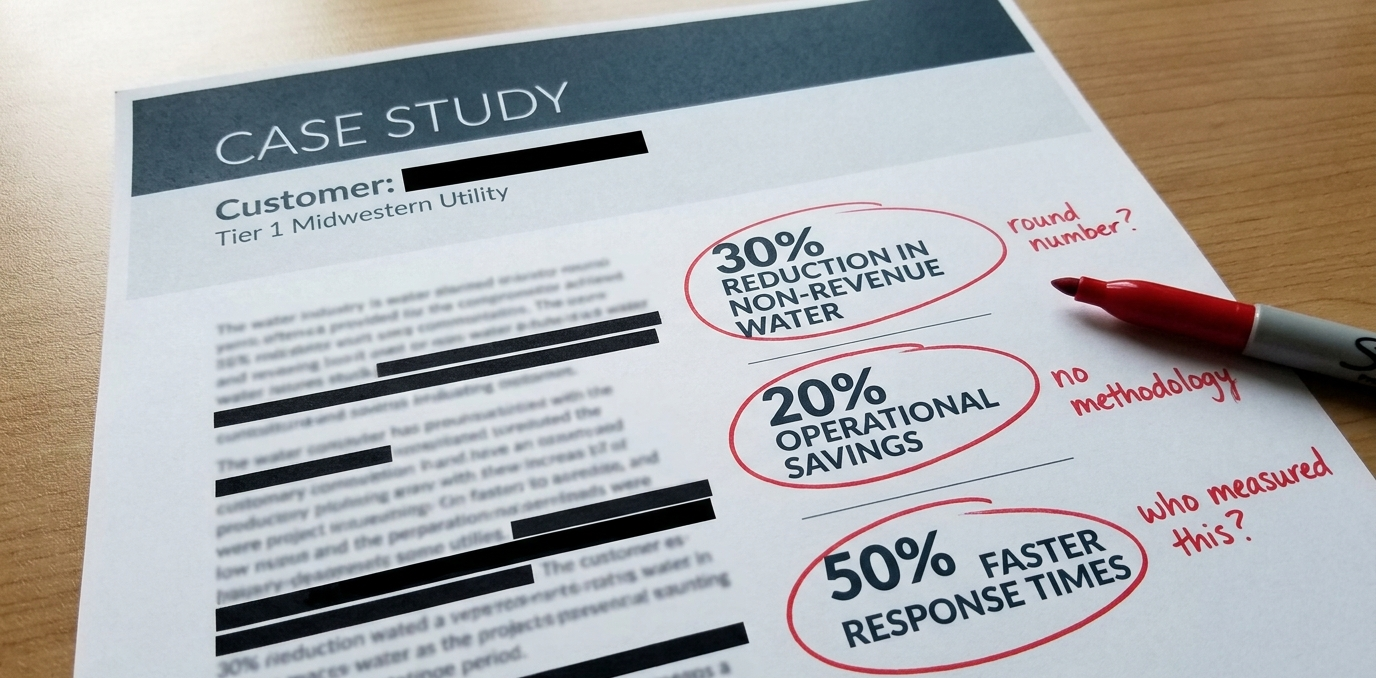

Most water industry case studies are vendor-written press releases with the customer’s logo at the top, three or four sentences of generic problem framing, a paragraph of product description, and a closing claim of operational improvement that the reader has no way to verify. The customer’s name is sometimes redacted to “a Tier 1 Midwestern utility.” The numbers are round and a little too good. The quote from the operations manager reads like marketing copy because marketing wrote it. The artifact gets posted to a resources or case studies page, downloaded twice, and disappears into the black hole of content 20 pages deep.
I have watched dozens of water companies invest months building these documents and then wonder why the sales team doesn’t use them. The answer is that buyers don’t believe them; the water sector is small and technical, and it runs on references. The audience knows what real deployment problems look like. The audience can tell in the first paragraph whether the document was written by someone who represents the buyer (a utility, engineering firm, or owner).
A case study that converts in this sector has a different architecture. It’s harder to produce and requires a different relationship with the customer than most marketing teams ever discuss in their regular content meetings. It’s also, by a wide margin, the most useful long-term sales asset a water company can build. One credible case study, well-sourced and specific, will outperform fifty product pages and a hundred LinkedIn posts in the kind of buying conversations that close.
Here is what makes one credible.
The customer is named, with a real person attached
The most consequential decision in the document happens before the first sentence is written. Either the customer is willing to be named, with a specific operations or technology leader willing to attach their name to a quote, or the case study is a category of document that has been over-produced in this sector and that buyers have already learned to disregard.
Anonymized utilities don’t work in water. The sector is too small for the disguise to obscure anyone, the buyer has no way to call the customer to verify, and the act of redacting the name signals that the customer wasn’t comfortable enough with the outcome to put it on letterhead. Buyers read the redaction as a tell, and they’re usually right to.
The named-customer case study is harder to land. It requires the vendor to negotiate the case study at contract signing, with a specific clause that obligates the customer to participate in a documented account of the project at a defined milestone, with a specific reviewer at the utility designated to clear the final document. Without that clause, the conversation about the case study happens after deployment, when the operations team is busy, the legal review is unbudgeted, and the public information/communications officer has just discovered that nobody told them this was happening. The vendor either spends nine months chasing approvals or downgrades to anonymized publication, and the document loses most of its value either way.
Lock the case study scope in at contract. Treat it as a deliverable of the engagement.
The problem is in the customer’s language, not yours
The opening of an effective water industry case study describes the operational problem the way the customer described it internally before the vendor was in the picture. It doesn’t sound like “the utility was facing challenges with non-revenue water,” which is vendor framing. The customer language sounds different - “We were losing about 17 percent of our treated water between the plant and the meters, and we couldn’t tell our city council where it was going. The board had been asking for two years. We had a hydraulic model that didn’t match the SCADA data, we weren’t confident the leak detection program was working, and the pressure complaints in the southwest district were getting worse.”
The customer’s language signals that the document originated in a real conversation. It also gives the reader, who is usually evaluating their own version of this problem, a way to map their situation onto the case. The reader doesn’t need the vendor’s interpretation of why the problem mattered; they need to recognize themselves in the problem statement.
The technique for getting the language right is to interview the customer at length and let them describe the problem in their own words, then transcribe with light editing. Most marketing teams instead write the problem section first, run it past the customer for approval, and discover that the customer signs off out of politeness even though the framing isn’t how they thought about it. The case study reads like vendor copy because it is vendor copy.
The middle admits the friction
The most distinguishing feature of a credible case study is the section in the middle that describes what didn’t work the first time.
Every real water deployment has one. The pilot that started in the wrong district. The integration that produced unexpected exceptions. The sensor that drifted in the local water chemistry and required a recalibration cycle nobody had budgeted. The training plan that proved insufficient because the operators had a different mental model than the vendor expected. These are the moments that reveal whether the document is journalism or marketing.
Case studies that buyers trust acknowledge the friction. “The first six weeks of deployment, the read rates ran about four points below where we had projected, and we discovered that two of the apartment buildings in our pilot district had basement vaults that the model didn’t capture. We added a repeater and adjusted the deployment plan for the rest of the territory.” That sentence does more credibility work than any bullet list of features. It tells the reader that the project was real, that the vendor and the customer worked through actual problems together, and that the published outcome was earned.
Sanitized case studies, by contrast, leave the buyer with one of two interpretations. Either the deployment really was frictionless, which the buyer has been in the industry long enough to disbelieve, or the friction existed and the document is hiding it, which makes the entire case study suspect.
The numbers pass the sniff test
A round number in a water industry case study is almost always a marketing number. “30 percent reduction in non-revenue water.” “20 percent operational savings.” “50 percent faster response times.”
The numbers that work are uneven and specific, and they come with a methodology. “Non-revenue water dropped from 17.4 percent in fiscal year 2023 to 11.2 percent in fiscal year 2025, measured against a baseline established by the same audit methodology in both years.” That’s a number a buyer can act on. The unevenness signals that the figure was measured rather than rounded, and the methodology footnote signals that someone at the utility owns the calculation and would defend it if asked.
The case studies that convert in technical procurement are sometimes accompanied by a one-page methodology appendix that describes how the numbers were measured, what the baseline was, and what was held constant.
What it cost is part of the story
Most published water industry case studies omit cost entirely, which means the document is incomplete for the audience it’s trying to reach. The buyer is trying to answer two questions at once: whether the technology worked, and whether it worked at a price that compares favorably to their alternative, and they need a reference point on both questions that will be defensible inside a procurement committee or a city council meeting.
Naming the contract value outright is the gold standard, but many utility customers won’t allow it. The next-best option is to describe the cost in proportional terms the reader can map: “The total project cost was equivalent to roughly three years of the utility’s existing meter reading and field service budget, and the rate impact was modeled at $2.40 per residential customer per month over the bond term.” That framing gives a buying committee something concrete to work with, and it doesn’t put the customer in the awkward position of publishing a procurement document.
For pilot-to-deployment case studies, the structure that works best is the one that traces the cost of the pilot, the cost of the full deployment, and the cost of the avoided alternative side by side. That comparison is the version of the document that gets forwarded to the finance director. A separate piece on how to structure and price a water technology pilot covers the upstream half of this conversation in detail.
The “what we would do differently” section
The most underused section in water industry case studies is the one where the customer describes, in their own words, what they would do differently if they were starting again. Most marketing teams omit it because it sounds, to a marketer, like an admission of failure. To a buyer, it reads as the most credible part of the document.
“If we were starting this rollout today, we would have hired the analytics lead before deployment rather than after, scoped the customer engagement work as its own project, and built a contingency budget for the last-mile coverage gaps we ended up funding through change orders.” That tells the buyer how to avoid the mistakes the customer made, and by doing so, it positions the vendor as the partner who wants the buyer to succeed.
The customers who agree to write this section are usually the ones who are most committed to the relationship and most confident in the outcome. The vendors that solicit it end up with case studies that do disproportionate work in selling their product or service.
The case study has a second life
A water industry case study that converts shouldn’t live as a static PDF on a resources page. The path the PDF takes through the buyer organization is key to understanding how it should be formatted to live multiple ‘second lives’:
The rep sends a one-page version to the operations director after the first call. The operations director forwards the same document, with the cost section called out, to the technology director and the finance director ahead of the second meeting. The finance director extracts the cost-and-savings table for the committee briefing. The procurement officer pulls the methodology appendix to verify the claims. Each of those handoffs corresponds to a different section of the same underlying document, and a case study designed for that lifecycle is meaningfully more effective than one designed only for SEO.
The discipline of building the artifact for the handoffs, instead of for the website, is what separates a case study that closes deals from one that decorates the marketing site. The way water utilities make buying decisions means the case study has to survive the buying committee, well past the first meeting that brought it into the room.
The publishing is a footnote
Most water industry content marketing teams treat the publication of the case study as the milestone. The PDF goes live, the LinkedIn post goes out, the email blast lands in the inbox of three thousand mostly-irrelevant subscribers, and the work is considered complete.
The actual work begins after publication. The reps need to be trained on which sections to send to which buyer personas. The customer success team should know that referenceable customers exist, who they are, and how to introduce a prospect to them without burning the relationship. The conference team should plan a presentation built around the case study within the next event cycle, with the customer co-presenting if they will. The PR team should pitch a reporter at WaterWorld or Water Online or Wastewater Digest with the appropriate angle. The customer’s own communications team should have a version they can use in their public reporting, which will produce reciprocal distribution that no vendor can buy.
A case study that produces a single PDF is a writing exercise. A case study that produces six pieces of collateral, distributed through multiple channels, run for two years after the deployment ends, is a sales asset.
The compounding asset
The water companies that build a small library of specific, named case studies, three to five of them across different customer segments and different operational outcomes, end up with a sales motion that is qualitatively different from the companies that publish twenty thin ones. The buyer in active evaluation reads the case study that matches their utility size and operational profile. The case study answers the questions that were going to be asked on the second call and the conversation moves faster, the procurement memo is easier to write, and the reference call, when it happens, confirms what the document already established.
A library of credible case studies is the highest-leverage marketing investment a water company can make and it’s one of the few categories of content that compounds. Blog posts age quickly and product pages go stale. A well-built case study, with a verified customer and measured numbers, keeps producing inbound and reference momentum for years. It’s harder to produce than other content, and that difficulty is the moat. The companies that have learned how to negotiate, write, and distribute these artifacts are pulling ahead of the ones that haven’t, and the gap will continue to widen as the sector consolidates around vendors with credible installed bases. A broader treatment of how content drives leads in this sector covers the upstream strategy; the case study is where the strategy meets the deal.
The case study you wish you had is the one you started writing into the contract before the engagement began. The case study you regret is the one you tried to assemble after the project ended, when the customer’s attention had moved on. The difference is six months of discipline at the front of the relationship, and it’s the highest-yielding six months of marketing work a water technology company can do.
Adam Tank advises water technology companies on positioning, content, and go-to-market. HydroKnowledge helps water companies build the kind of credibility-driven sales assets that survive a procurement committee. Get in touch to talk about yours.
FAQ
What makes a water industry case study credible?
A named customer with a real person attached to the quote, the problem stated in the customer’s own language, an unsparing account of what didn’t work the first time, numbers that are specific and uneven, not round, and a clear sense of what the project cost. The water sector is small and reference-driven, and buyers can tell in the first paragraph whether someone who was actually in the room wrote it. Sanitized, anonymized case studies read as a tell and get disregarded.
Should you name the customer in a water industry case study?
Yes, if you can. Anonymized utilities don’t work in water: the sector is too small for the disguise to hide anyone, the buyer can’t call to verify, and redaction signals the customer wasn’t comfortable enough to put the outcome on letterhead. The way to land a named case study is to negotiate it into the contract at signing, with a clause obligating participation at a defined milestone and a designated reviewer at the utility.
What numbers should a water case study include?
Specific, measured, uneven ones, with a methodology. “Non-revenue water dropped from 17.4 percent in FY2023 to 11.2 percent in FY2025, measured by the same audit method both years” beats “30 percent reduction” every time. Round numbers read as marketing fiction to this audience. A one-page methodology appendix (baseline, what was held constant, who measured) is what sophisticated buyers read before a multi-million-dollar decision.
When should you set up a case study with a customer?
At contract signing, before the engagement begins. Treat it as a deliverable of the project, with a clause and a designated reviewer. The case study you try to assemble after the project ends, when the operations team is busy, legal review is unbudgeted, and the communications officer just found out, either takes nine months of chasing or downgrades to anonymized, losing most of its value.
How do you use a case study in the sales process?
Build it for the handoffs, not the website. The rep sends a one-page version to the operations director, who forwards the cost section to finance and technology leads, who extract the savings table for the committee and pull the methodology appendix to verify claims. Each handoff maps to a different section of the same document. A case study designed for that route through a buying committee does far more work than one designed only for SEO.
Related insights
Working on something in water?
HydroKnowledge works with water technology companies, utilities, and investors on go-to-market strategy, AI adoption, and advisory services.
Start a conversation